Upstox Originals
How AI is making cancer care safer and smarter in India

4 min read | Updated on December 15, 2025, 21:36 IST


SUMMARY
Artificial Intelligence could revolutionise cancer care in India with accurate early detection and tailored treatment for different cases. Government and private institutes are trying their best to use AI in clinical systems but the common challenges like regulation, inconsistent datasets and infrastructure gaps remain. Will AI be able to make a real difference in this crucial fight against cancer?
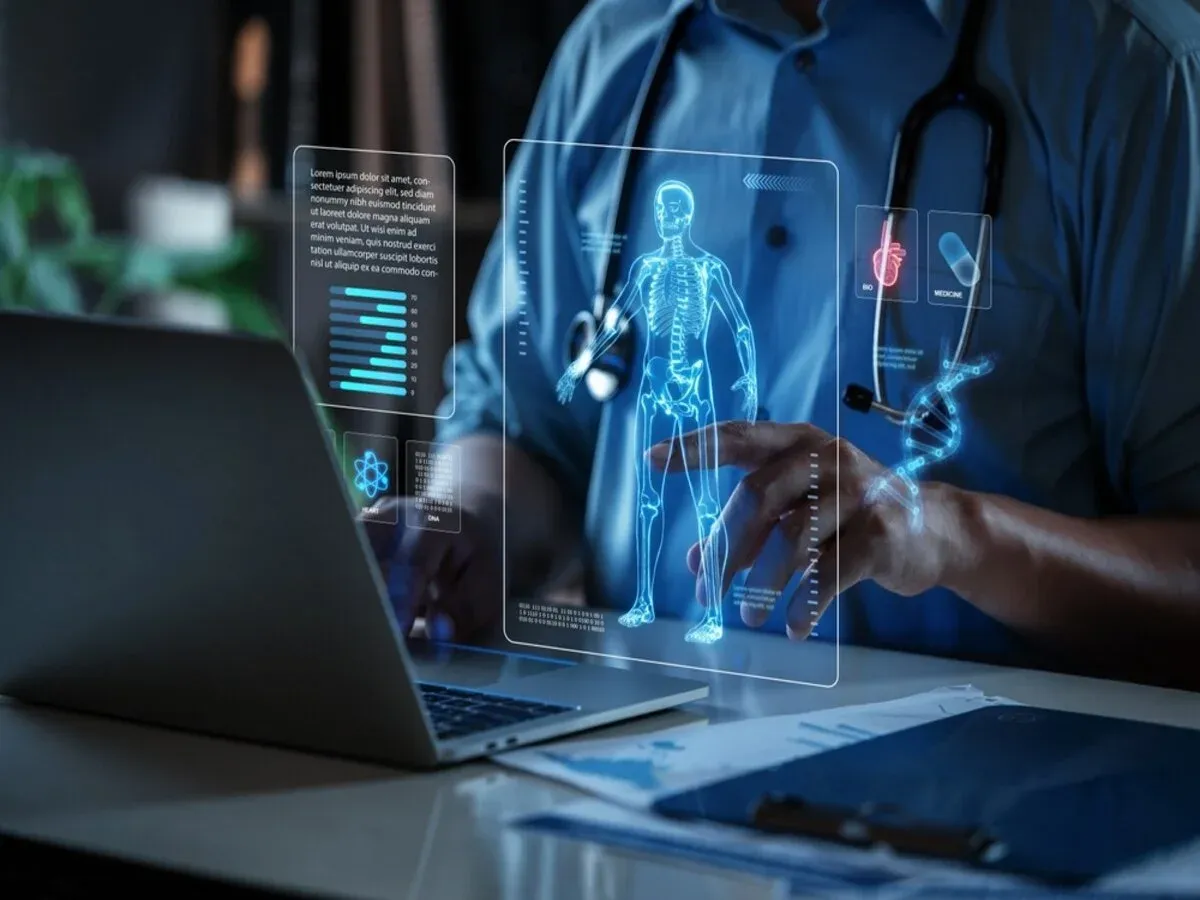
Indian scientists have developed an AI framework for personalised cancer therapy, giving us a new lens to look at the disease | Image: Shutterstock
Understanding and treating cancer has baffled humans for a long time. What if Artificial Intelligence (AI) could give patients a new lease of life by helping diagnose the disease early on or through targeted treatment plans? AI is bringing about many changes in healthcare but is it benefiting people on the ground?
AI for cancer care
Spotting danger before it becomes a crisis is critical in the fight against cancer. That’s where AI comes in. In fact, these AI-powered tools are not just accurate, they are rapidly improving, jumping from being 80% accurate in early detection in 2017 to 90% in 2022. A case in point is the Tata Memorial Hospital in Mumbai which achieved a 40% reduction in radiation by using AI to enhance images for early-stage detection.
The government and its premier institutions are funding and deploying AI solutions in oncology with an aim to bring costs down and save lives. The IndiaAI Mission and National Cancer Grid (NCG) are providing pilot funding across the NCG hospital network. The iOncology-AI project launched by AIIMS Delhi and MeitY developed an AI-powered supercomputer to aid oncologists. Tata Memorial Hospital’s bio-imaging bank has incorporated data from 60,000 patients to create a cancer-specific deep-learning algorithm for early detection and personalised care. The efforts are on at many levels to beat the disease and reduce costs of treatment.
Reading the molecular ‘mind’ of cancer
AI is not just spotting the threat but is also adept at developing personalised treatment plans. Every case is unique and only personalised treatment plans can achieve desired results. Recently, Indian scientists have developed an AI framework for personalised cancer therapy. The framework, developed by scientists of S N Bose National Centre for Basic Sciences in coordination with Ashoka University, gives us a new lens to look at cancer—not by its size or spread alone, but by its molecular personality. It’s the first AI framework that can read the molecular “mind” of cancer and predict its behavior. This is a breakthrough for targeted therapy and personalised treatment. This innovative breakthrough could only be achieved through AI.
Scaling up AI in India’s cancer care
AI can bring about a huge difference in the way the disease is treated but the technology will take time in reaching the last mile. There are infrastructural challenges, data limitations, regulatory uncertainties and several other issues in scaling up use of AI for the common man. It’s taking time for the clinical systems to adopt it.
Infrastructure gaps
Infrastructure gaps in the form of a lack of computing power, reliable energy, trained workforce exist which are a hurdle in scaling up.
Inadequate and inconsistent data
Many hospitals in smaller towns still rely on paper-based records or disparate electronic health record systems. This leads to a lack of clean, large datasets for AI training. AI models are trained on international datasets which may be irrelevant for India. A lack of high-quality Indian cancer patient data can lead to biases and wrong diagnoses.
Regulatory and ethical challenges
The landscape for regulations is still evolving. This creates uncertainties for medical professionals and developers. There is no clear guidance from the Central Drugs Standard Control Organisation on certification processes for AI devices. Then there is the question of patient data privacy. Developers have to navigate compliance with the evolving Digital Personal Data Protection Act (DPDP). Clear guidelines are also needed around accountability if AI falters in a diagnosis or treatment.
Human factors
There is a scarcity of professionals trained in AI, biomedical engineering and data science who can deploy and analyse AI in clinical settings. AI aims to reduce costs in the long run but in the short term it could drive up costs creating a perception of high costs for smaller hospitals.
Despite all these challenges, which could be overcome through standardised data collection, training programmes, policy initiatives, AI in cancer care can really change the game for the medical fraternity and patients. If used well, it could be the weapon we currently need for the disease.
By signing up you agree to Upstox’s Terms & Conditions

About The Author
Next Story